
Build a Social Media System for Solo Business
Solo Business, Social Media Systems
How Do You Build a Social Media System When You’re Running a Business Alone?
You build a social media system as a solo business owner by simplifying your strategy, choosing just one or two core platforms, batching your content, and using basic automation tools to handle posting and repurposing. Instead of trying to “be everywhere,” you create a repeatable weekly workflow: plan your content around a few key themes, draft posts in batches, schedule them in one sitting, and set aside short, focused time blocks to engage with your audience. The goal is not perfection or viral growth; it’s a sustainable, low-stress system that supports your business without taking it over.
In practice, this means defining clear objectives (e.g., get leads, book calls, sell products), aligning your content with those goals, and building simple routines you can actually keep: a weekly planning session, one or two content creation blocks, and daily 10–15 minute check-ins. With a few templates, a content “idea bank,” and light automation, your social media starts working for you, even when you’re busy wearing every other hat in your business.
Key Takeaways: Your Social Media System in a Nutshell
Start with purpose, not platforms: Decide what social media should actually do for your business (leads, awareness, sales, authority) before worrying about where to post.
Choose 1–2 primary platforms: As a solo owner, depth beats breadth. Show up consistently in a couple of places instead of inconsistently everywhere.
Use content pillars: Pick 3–5 recurring themes (like education, behind-the-scenes, social proof) so you never start from a blank page again.
Batch and schedule: Create several posts at once and schedule them weekly, so social media runs in the background while you run your business.
Repurpose smartly: Turn one core piece of content into multiple posts instead of reinventing the wheel every time you log in.
Timebox engagement: Use short, focused daily check-ins (10–15 minutes) to reply, comment, and build relationships without getting sucked in for hours.
Track simple metrics: Focus on a handful of numbers that actually matter (profile visits, website clicks, inquiries) instead of obsessing over vanity metrics.
Step 1: Get Clear on Why You’re Using Social Media at All
When you’re running a business alone, time is your most valuable resource. The only way social media becomes an asset instead of a distraction is if it has a clear job. Before you pick platforms or brainstorm content, define what “success” looks like for you over the next 3–6 months.
Do you want to book more discovery calls or consultations?
Do you want to sell more products from your online shop?
Do you want to grow an email list that you can market to directly?
Do you want to build authority so people trust you faster?
Pick one main objective and one secondary. For example: “My main goal is to grow my email list by 200 subscribers; my secondary goal is to build authority in my niche.” This will guide what you post, what you promote, and how you measure results. Without this clarity, it’s easy to feel busy on social media but see little business impact.
💡 Pro Tip: Write your main goal on a sticky note and keep it near your workspace. Before posting, ask, “Does this move me closer to that goal?”
Step 2: Choose the Right Platforms (and Say No to the Rest)
As a solo business owner, you simply don’t have the capacity to do Instagram, TikTok, LinkedIn, Facebook, YouTube, Pinterest, and X well at the same time. The good news is: you don’t need to. Most small businesses can grow steadily by focusing on one primary platform and one supporting platform.
Choose based on where your audience already spends time and what type of content you can realistically create. For example:
Instagram or TikTok if your business is visual, lifestyle, or product-based, and you’re comfortable with short video and photos.
LinkedIn if you sell B2B services, consulting, or work with professionals or companies.
Facebook if your local community or existing customers are active in groups and pages there.
YouTube if you can commit to slightly longer, educational videos that build trust over time.
Commit to your chosen platforms for at least 90 days. During that time, ignore the pressure to jump onto every new trend or app. Consistency on a few channels will beat scattered effort across many, especially when you’re doing everything yourself.
Step 3: Build Simple Content Pillars So You Never Start from Zero
Content pillars are 3–5 core themes you talk about repeatedly. They keep your messaging focused, make planning easier, and help your audience quickly understand what you’re about. As a solo owner, they’re also a powerful way to reduce decision fatigue.
A simple set of pillars for a one-person service business might look like this:
Education: Tips, how-tos, quick wins, myth-busting posts that help your audience solve problems.
Behind the Scenes: Your process, your tools, day-in-the-life snapshots, your story as a founder.
Social Proof: Client results, testimonials, reviews, before-and-afters, case studies in simple language.
Offer-Focused: Clear posts about what you sell, who it’s for, and how to buy or book.
Once you have your pillars, your weekly planning becomes much easier. Instead of asking, “What should I post?” you ask, “What’s one educational post, one behind-the-scenes post, one proof post, and one offer post I can share this week?”
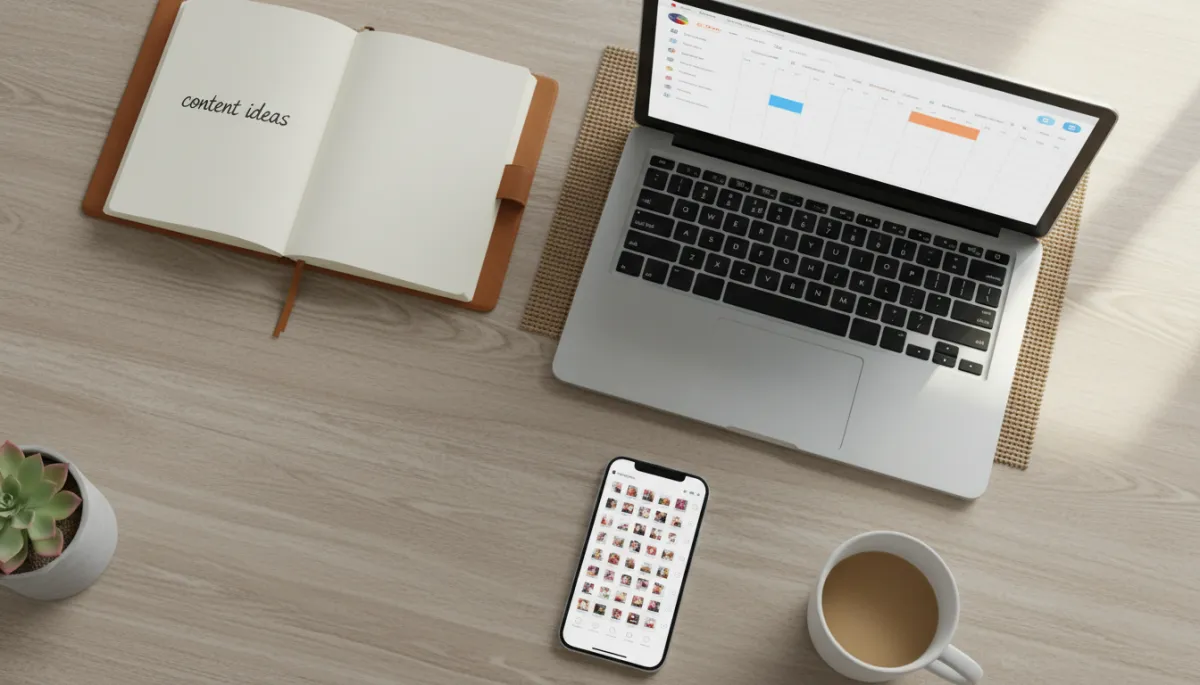
A simple idea bank and planner turn social posting from chaos into a repeatable routine.
Step 4: Create a Weekly Workflow You Can Actually Stick To
A “system” is really just a set of repeatable actions. For a solo business owner, the key is to keep your social media workflow lean and realistic. Here’s a sample weekly routine you can adapt:
30–45 minutes: Plan – Choose your posts for the week using your content pillars. Jot down rough ideas or bullet points for each one.
60–90 minutes: Create – Write captions, record short videos, or take photos in one focused block. Don’t edit as you go; aim to get everything drafted first.
30 minutes: Schedule – Use a free or low-cost scheduler to queue your posts for the week at times your audience is most active.
10–15 minutes per weekday: Engage – Reply to comments and messages, comment on other people’s content, and connect with potential customers or collaborators.
Altogether, this can be done in about 3–4 hours a week, spread over a few days. That’s still a commitment, but it’s manageable, especially when most of the heavy lifting (planning, creating, scheduling) happens in just one or two blocks of time.
💡 Pro Tip: Put your social media blocks on your calendar like client appointments. If you don’t schedule them, they’ll slide to “someday” and never happen consistently.
Step 5: Use Light Automation and Templates to Save Your Energy
You don’t need complicated software to build a social media system. A few simple tools and templates can dramatically reduce the mental load and time required each week. Consider:
A basic content calendar in a spreadsheet, notes app, or project tool to map out posts by day and theme.
Caption templates you reuse, such as “Hook → Value → Call to Action” or “Problem → Mistake → Better Way.”
A few reusable graphic or video templates with your brand colors and fonts so your posts look consistent without extra design time.
A simple scheduling tool (or native platform scheduler) that lets you batch posts for the week.
The goal is to make “doing social media” feel like following a checklist, not inventing a new process every time. Over time, you’ll refine your templates based on what resonates with your audience and what feels natural for you to create.
Step 6: Repurpose Content So One Idea Works Harder for You
As a solo owner, you can’t afford to create every post from scratch. Repurposing is how you get more reach and impact from the same ideas. Start by creating one “core” piece of content each week or month, then break it down into smaller pieces for social media.
For example, if you write a blog post or record a longer video, you can turn it into:
3–5 short tips posts, each highlighting one key point.
A short video summarizing the main idea in under a minute.
A carousel or multi-image post walking through a step-by-step process.
A quote graphic using a memorable line or statistic from your content.
You can also repurpose across time. If a post worked well three months ago, there’s nothing wrong with updating it slightly and sharing it again. Most of your audience didn’t see it the first time, and those who did may appreciate the reminder.
Step 7: Timebox Engagement and Protect Your Focus
Social platforms are built to keep you scrolling. As a business owner, you need to be intentional about how you spend your time there. Timeboxing—setting a clear start and end time for a task—is a simple way to stay in control.
Schedule one or two short engagement windows a day, such as 10 minutes in the morning and 10 minutes mid-afternoon.
During that time, focus only on purposeful actions: replying to comments, answering DMs, commenting thoughtfully on posts from potential clients or peers, and participating in relevant groups or threads.
When the time is up, log out or close the tab and move on to your next scheduled task.
This simple boundary allows you to stay responsive and build relationships without sacrificing deep work time for client projects, operations, or strategy—the things that actually move your business forward.
Step 8: Track a Few Key Metrics (and Ignore the Noise)
It’s easy to get obsessed with likes and follower counts, but those numbers don’t always reflect business growth. For a solo owner, your social media metrics should be simple, easy to check, and directly tied to your goals. Once a week or once a month, look at:
Profile visits and website clicks – Are people curious enough to learn more about you?
Leads and inquiries – How many DMs, emails, or form submissions mention finding you on social media?
Email list sign-ups – If growing your list is a goal, is social media driving sign-ups for your lead magnet or newsletter?
Top-performing posts – Which posts get the most saves, shares, or meaningful comments? Create more like those.
Over time, these simple numbers will tell you what’s working and what’s not. Use them to adjust your content pillars, posting frequency, or calls to action, but avoid changing everything based on one “bad” week. Focus on trends over time, not daily fluctuations.
Step 9: Give Yourself Permission to Keep It Human and Imperfect
Finally, remember that your biggest advantage as a solo business owner is that you’re a real person. You don’t need agency-level production to be effective. Your audience cares more about clarity, consistency, and authenticity than flawless editing or daily posting.
It’s okay if you miss a day or if a post doesn’t perform well. It’s okay if your early videos feel awkward. What matters is that you keep showing up, refining your system, and letting your social media support your business rather than define your worth as a business owner.
Frequently Asked Questions About Building a Social Media System Solo
How many times a week should I post if I’m running everything alone?
For most solo business owners, 3–5 posts per week on your main platform is a sustainable starting point. If that still feels like too much, begin with 2–3 high-quality posts and focus heavily on engagement and building relationships. It’s better to post less often but consistently than to post daily for two weeks and then disappear for a month.
Do I really need to be on video to succeed on social media?
Video can help you build trust faster, but it’s not the only way to grow. If video feels intimidating, start small: short clips, screen recordings with voiceover, or simple talking-to-camera videos filmed on your phone. In the meantime, you can still grow using written posts, carousels, photos, and stories. Over time, many business owners find video gets easier with practice.
What if I don’t have time to create original content every week?
That’s where batching and repurposing become essential. Try setting aside one half-day each month to create a batch of content you can draw from for several weeks. Use your content pillars to outline ideas in advance, then turn each idea into multiple formats. You can also mix original content with curated content, such as sharing useful resources or industry news with your own commentary.
Should I outsource my social media as a solo business owner?
Outsourcing can be helpful once you have a basic system in place and you understand what works for your audience. In the early stages, it’s often better to manage it yourself so you can develop your voice, test ideas, and learn what resonates. Later, you can delegate tasks like scheduling, basic design, or repurposing while you stay involved in strategy and key messaging.
How long will it take before I see results from my social media system?
Results vary by industry, offer, and platform, but a good rule of thumb is to commit to 90 days of consistent effort before judging your system. During that time, refine your content based on feedback and metrics, but avoid constantly switching strategies. Many solo owners start to see clearer traction—more inquiries, stronger engagement, and better brand recognition—after a few months of focused, consistent posting and engagement.
Conclusion: A Social Media System That Works With You, Not Against You
Building a social media system when you’re running a business alone is less about doing everything and more about doing the right things consistently. By defining your goals, choosing one or two platforms, creating simple content pillars, and following a realistic weekly workflow, you can stay visible online without sacrificing your sanity or your core business responsibilities.
Remember: your system doesn’t need to look like anyone else’s. Start small, keep it simple, and let your process evolve as you learn what works. With time, your social media presence will become a quiet but powerful engine in the background of your business—bringing in new relationships, opportunities, and revenue while you stay focused on the work only you can do.
Have Questions? Book a free discovery call with Patrick Smith at meetpatricksmith.com.