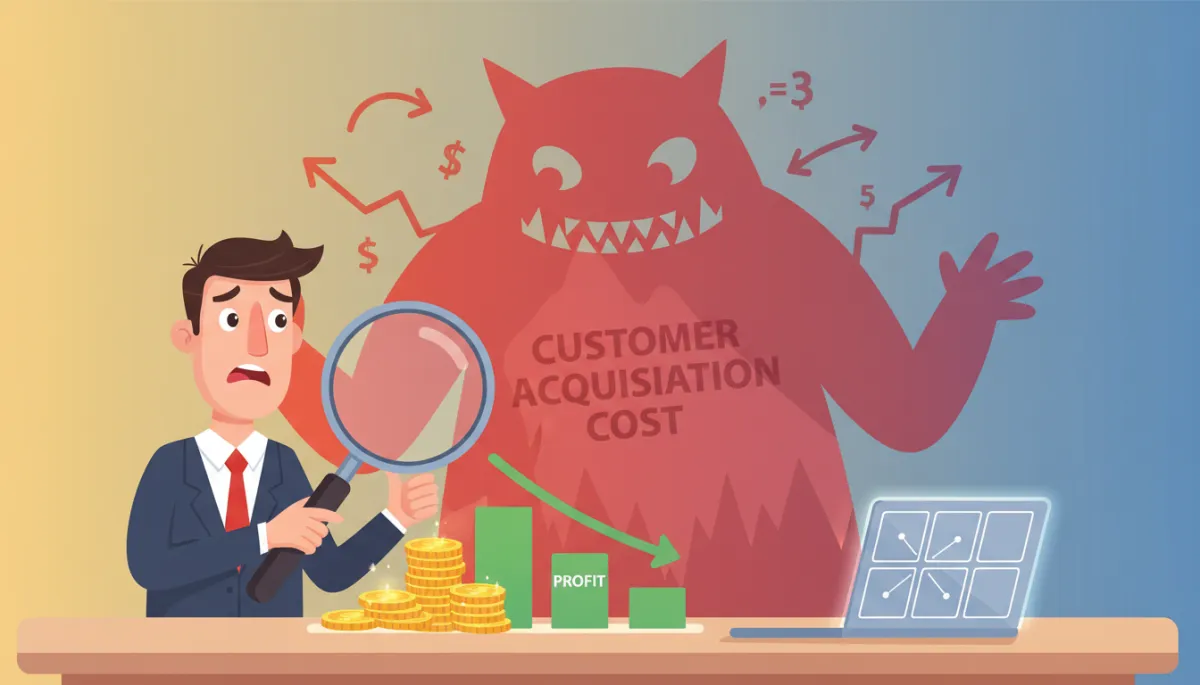
Understanding Customer Acquisition Cost & Profit Impact
Marketing, Customer Acquisition, Profitability
What Is Customer Acquisition Cost and Why Is It Quietly Killing Your Profit Margin?
Customer Acquisition Cost (CAC) is the total amount you spend to win a new customer, including marketing, sales, and related overhead. When CAC climbs higher than you realize—or grows faster than your average revenue per customer—it quietly erodes your profit margin, leaving you working harder, selling more, and still wondering where the money went. If you don’t measure and manage CAC, you can appear to grow on paper while actually losing profit with every new customer you bring in.
In other words, CAC is the “price tag” of growth. When that price tag is too high, every marketing win becomes a financial loss. Understanding what CAC is, how to calculate it, and how to lower it is one of the fastest ways to protect—and grow—your margins without burning out your team or your bank account.
Key Takeaways
Customer Acquisition Cost (CAC) is the total cost of winning a new customer, including ads, software, salaries, and overhead tied to marketing and sales.
High or rising CAC quietly kills profit margins when it approaches or exceeds your Customer Lifetime Value (CLV) or average order value.
Many businesses underestimate CAC by ignoring hidden costs like discounts, agency fees, and time spent by founders or sales teams.
A healthy business typically aims for a CLV-to-CAC ratio of at least 3:1, meaning you earn three dollars for every dollar you spend to acquire a customer.
You can protect your margins by tracking CAC by channel, improving conversion rates, and increasing customer retention and repeat purchases.
What Exactly Is Customer Acquisition Cost (CAC)?
Customer Acquisition Cost is a simple idea with big consequences. At its core, CAC answers one question: “How much does it cost us, on average, to get one new paying customer?” It is not just your ad spend or your latest campaign budget. It is the all-in cost of turning strangers into customers over a specific period of time.
The basic formula looks like this:
CAC = (Total Sales & Marketing Costs in Period) ÷ (Number of New Customers Acquired in Same Period)For example, if you spend $10,000 in a quarter on ads, sales salaries, marketing tools, and agency fees, and you acquire 100 new customers, your CAC is $100. That means each new customer effectively costs you $100 to win. If the average customer only brings in $80 in profit over their lifetime, you are losing money every time you “successfully” sell to someone.
What Should Be Included in CAC (and What Most People Miss)
One of the reasons CAC quietly kills profit margin is that many business owners undercount it. They look at ad spend alone and ignore everything else. In reality, CAC should include any cost directly tied to acquiring new customers. That usually means:
Paid advertising (search, social, display, sponsored content)
Marketing and sales salaries and commissions (or a reasonable portion of them)
Marketing software and tools (email platforms, CRM, landing page builders, analytics tools)
Agency and consultant fees related to marketing and lead generation
Creative costs (design, copywriting, video production for campaigns)
Promotional discounts or referral fees used to close new customers
💡 Pro Tip: Don’t forget to include your own time if you are the founder handling sales calls or marketing strategy. Your time has a cost, and ignoring it makes CAC look artificially low.
When you start adding these hidden costs, CAC often jumps dramatically. That jump is not bad news—it is a clearer picture. Once you see the real number, you can start making better decisions about where to invest, what to cut, and which channels are truly profitable.
Why High CAC Quietly Destroys Your Profit Margin
Profit margin is what is left after you subtract all your costs from your revenue. If your CAC is high, you are effectively giving away a big slice of your margin every time you acquire a new customer. The danger is that this often happens silently. Revenue grows, you are busier than ever, and yet your bank account does not reflect the hustle. Here is why:
You focus on top-line growth instead of bottom-line health. Vanity metrics like followers, clicks, and even sales can look great while your actual profit shrinks because CAC is too high.
You assume “more customers” automatically means “more profit.” If each customer costs $150 to acquire and only generates $140 in profit, scaling just multiplies your losses.
You ignore the relationship between CAC and lifetime value (CLV). Without comparing CAC to what a customer is worth over time, you cannot see whether your acquisition strategy is sustainable.

Pixar Style color palette bar chart characters where a tall smiling CLV bar shakes hands with a...
Healthy margins appear when lifetime value comfortably towers over acquisition cost.
The Critical Link Between CAC and Customer Lifetime Value (CLV)
CAC alone does not tell the whole story. A “high” CAC can be perfectly acceptable if your Customer Lifetime Value (CLV) is even higher. CLV is the total revenue (or profit, if you prefer) a typical customer brings over the entire relationship with your business—from first purchase to last renewal or order.
A widely used benchmark is the CLV-to-CAC ratio. Many healthy, scalable businesses aim for at least a 3:1 ratio—meaning you earn three times in lifetime value what you spend to acquire a customer. If your ratio is 1:1, you are essentially breaking even on acquisition before you even consider overhead, delivery costs, or unexpected churn. Anything below that means you are paying more to get customers than they are worth to your business.
📌 Key Takeaway: CAC is only “expensive” or “cheap” when viewed in context. The real question is not “Is my CAC high?” but “Is my CAC high relative to my customer lifetime value?”
How to Calculate Your Real CAC Step by Step
Choose a time period. A month, quarter, or year all work. Just be consistent when comparing later.
List all sales and marketing expenses for that period. Include ad spend, salaries, commissions, tools, agencies, content creation, and relevant overhead.
Count the number of new customers acquired in that same period. Only include paying customers, not leads or free trials (unless a free trial is your main product).
Divide total cost by new customers. This gives you your average CAC for that period.
Once you have your overall CAC, you can get more sophisticated by calculating CAC by channel—paid search, organic content, referrals, events, etc. This helps you see which channels are truly efficient and which are draining your budget without delivering profitable customers.
Common Warning Signs Your CAC Is Killing Your Margin
You are spending more on marketing and sales every quarter, but profit is flat or declining.
Your team celebrates revenue milestones, yet cash flow always feels tight or unpredictable.
You rely heavily on discounts or promotions to close new customers, which eats into margin before CAC is even considered.
Paid campaigns “work” according to platform dashboards, but when you look at the full cost of acquisition, the numbers do not add up.
⚠️ Warning: Ad platforms are incentivized to show you click-through rates and conversions, not your true profit after CAC. Always cross-check platform metrics against your own CAC and margin data.
Practical Ways to Lower CAC Without Sacrificing Growth
1. Improve Conversion Rates Along the Funnel
If more of your existing leads become customers, your CAC naturally falls because you are getting more value from the same spend. Focus on:
Clearer messaging that speaks directly to your ideal customer’s pain points.
Simpler, faster checkout or sign-up processes with fewer steps and less friction.
Better follow-up systems (email sequences, reminders, demos) so warm leads do not go cold.
2. Double Down on High-Quality, Low-Cost Channels
Not all channels are created equal. Referrals, organic content, partnerships, and email marketing often deliver lower CAC than pure paid ads. Once you know your CAC by channel, shift more budget and energy toward the channels that deliver profitable customers at a lower cost—and trim or rework the others.
3. Increase Customer Lifetime Value (CLV)
Sometimes the fastest way to “fix” CAC is not to lower it, but to raise the value of each customer. You can do this by:
Introducing upsells, cross-sells, or premium tiers that increase average order value.
Improving onboarding and customer experience so customers stay longer and buy more often.
Launching loyalty or referral programs that keep customers engaged and bring in new ones at a lower cost.
4. Tighten Targeting and Positioning
When you try to speak to everyone, you end up paying more to reach people who will never buy. Clear positioning and well-defined customer personas allow you to target the right people with the right message, so each marketing dollar works harder. Better targeting means fewer wasted impressions and more qualified leads, which lowers CAC over time.
Frequently Asked Questions About Customer Acquisition Cost
What is a “good” Customer Acquisition Cost?
There is no universal “good” CAC number because it depends on your industry, pricing, and customer lifetime value. A $500 CAC might be terrible for a $60 product but excellent for a high-ticket service where customers stay for years. As a rule of thumb, aim for a CLV-to-CAC ratio of at least 3:1 and ensure your CAC leaves enough room for healthy profit after delivery and overhead costs.
How often should I review my CAC?
Reviewing CAC quarterly is a good starting point for most small and mid-sized businesses. If you are investing heavily in new campaigns or scaling quickly, monthly reviews can help you catch issues early and reallocate budget before losses compound. The key is consistency—track the same metrics over time so you can see trends, not just snapshots.
Should I use revenue or profit when comparing CAC to customer value?
Many businesses start by comparing CAC to revenue-based CLV because it is easier to calculate. However, a more accurate picture comes from comparing CAC to profit-based CLV—what you actually keep after direct costs. If your margins are thin, revenue comparisons can make acquisition look healthier than it really is. When in doubt, be conservative and use profit where possible.
Do repeat purchases affect CAC?
Yes, and this is where the power of CLV shows up. CAC is usually calculated based on the cost to acquire a customer the first time. Every repeat purchase after that effectively lowers your acquisition cost per purchase. That is why retention, customer experience, and upsell strategies are so important—they help you earn more from each customer without paying to acquire them again.
Can I grow fast and still keep CAC under control?
Absolutely—but it requires discipline. Rapid growth often pushes businesses to overspend on acquisition just to hit top-line targets. Sustainable growth comes from balancing speed with efficiency: tracking CAC closely, doubling down on profitable channels, and constantly improving conversion and retention. Growth at all costs is easy; profitable growth is a strategic choice.
Conclusion: Turn CAC From a Silent Killer Into a Strategic Advantage
Customer Acquisition Cost is not just another marketing metric—it is a direct line into the health of your profit margin. When you ignore it, CAC quietly eats away at your bottom line, leaving you wondering why “doing everything right” still does not feel profitable. When you understand it, measure it honestly, and manage it strategically, CAC becomes a powerful lever you can pull to protect and grow your margins.
By including all relevant costs, comparing CAC to customer lifetime value, and regularly reviewing your numbers, you can spot problems early and reallocate resources toward the channels and strategies that truly move the needle. Combine that with efforts to improve conversion rates and increase CLV, and you transform acquisition from a cost center into a competitive advantage.
If you are unsure what your real CAC is—or suspect it may be quietly killing your profit margin—you do not have to figure it out alone. A focused outside perspective can help you untangle the numbers, see the story they are telling, and design a clear plan to grow profitably instead of just growing noisily.
If you would like help calculating your true Customer Acquisition Cost, interpreting what it means for your margins, and building a practical strategy to lower CAC while increasing lifetime value, book a free discovery call with Patrick Smith at MeetPatrickSmith.com. Together, you can turn CAC from a silent threat into a clear, manageable metric that supports sustainable, profitable growth.