What Should Your Customer Follow-Up Messages Actually Say?
You set up the follow-up. You connected it to your CRM. You hit go. And then... nothing. Customers are not responding, not returning, and not leaving reviews. The problem is almost never the system. It is the message.
Most follow-up messages fail because they sound like they were written by nobody in particular for nobody in particular. This post is about fixing that. Here is exactly what your follow-up messages should say at each stage — and the principles that make them actually work.
Key Takeaways
The most effective follow-up messages are short, specific, and sound like they came from a real person.
Use the customer's name and a reference to their actual experience whenever possible.
Each message should have one purpose — do not combine a thank-you, a review request, and a promotion in a single text.
Tone matters as much as timing. Warm and direct always outperforms slick and promotional.
Your business has a voice. Use it in every message, or the messages work against your brand.
The Principles Behind a Follow-Up Message That Works
Before getting into exact language, there are four principles worth understanding. Get these right, and even a simple text becomes something a customer actually appreciates receiving.
1. One Message, One Job
Every message should do one thing. A thank-you message says thank you. A review request asks for a review. A reactivation message invites someone back. When you combine these — "Thanks for coming in! Leave us a review! Also, here is a coupon!" — the customer reads nothing, because the message has no clear direction.
2. Short Wins Every Time
A follow-up text should rarely be more than three sentences. An email can be a little longer, but the effective part is usually the first paragraph. If your message requires scrolling on a phone, it is too long.
3. Sound Like the Owner, Not the Software
This is the one most businesses get wrong. Automation does not have to sound automated. The voice in your messages should match the voice of your business — the way you talk to customers in person. If you are warm and a little informal, your messages should be too. If you are calm and professional, that comes through in the language. Your customers can tell the difference between a message that sounds like you and one that came from a template.
4. Give Before You Ask
The worst follow-up messages lead with a request. "Please leave us a review." "Book your next appointment." Instead, lead with something for the customer — a genuine thank-you, a useful tip, an acknowledgment of their experience. The ask, if there is one, comes after.
What to Say at Each Stage
The 24-Hour Thank-You (Text)
Purpose: Build warmth. Confirm they made the right choice. Open the channel.
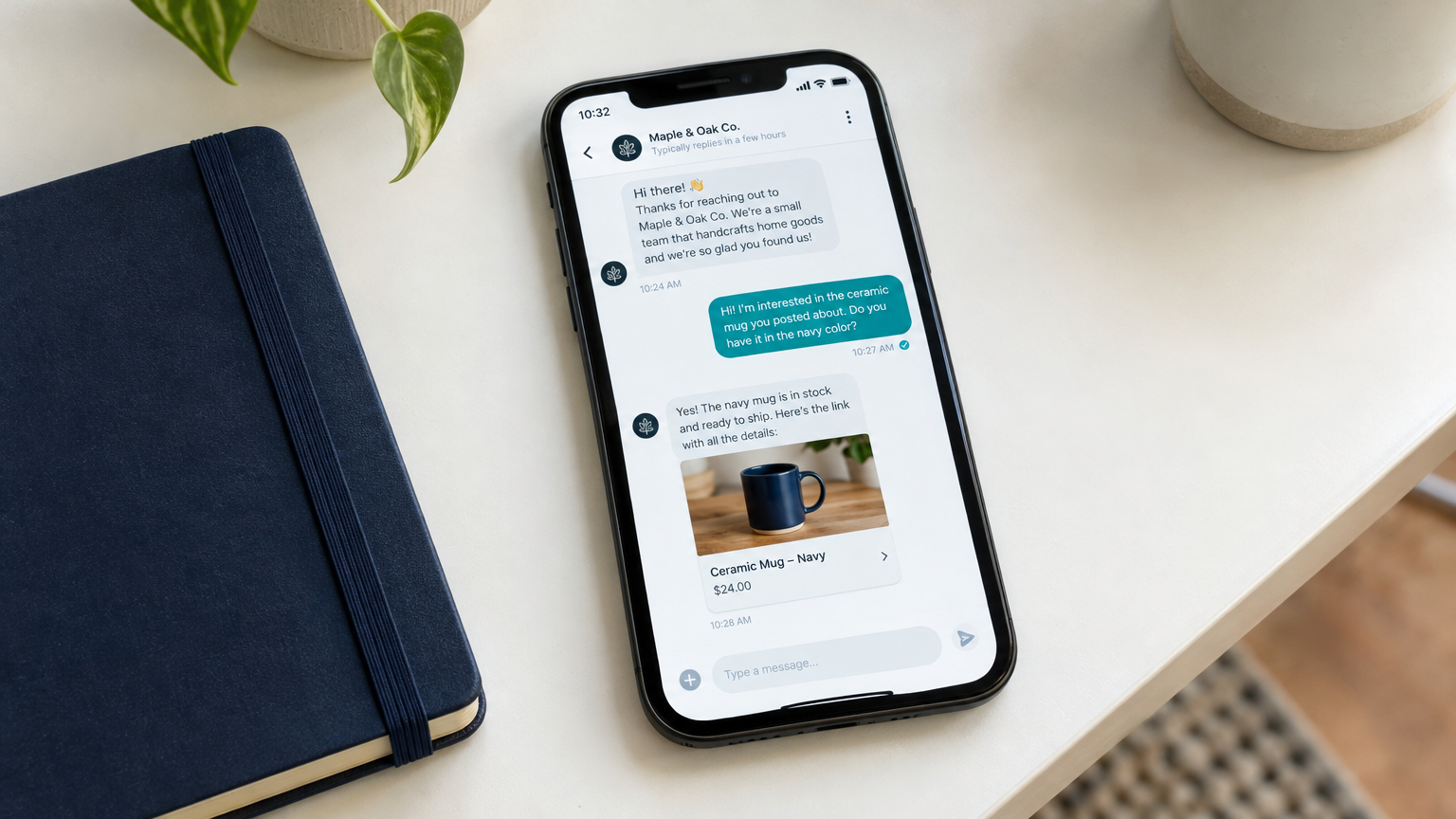
What works: "Hi [Name] — this is [Your Name] from [Business]. Just wanted to thank you for coming in today. I hope everything is going great. Feel free to reach out anytime."
What does not work: "Thank you for your recent visit! We appreciate your business. Please review us on Google."
The first message sounds like a person. The second sounds like a receipt.
The 5-Day Experience Check-In (Text or Email)
Purpose: Show you care about the result, not just the sale. Open the door to a review naturally.
What works: "Hi [Name] — checking in to see how everything went after your appointment. Did everything hold up okay? If you have a minute, an honest review on Google means a lot to us — [link]. Either way, hope you are doing well."
Why it works: The check-in comes first. The review request is framed as something that means something to the business — not a box to be checked.
If you want to understand the full review-building process, our post on getting more 5-star Google reviews without asking every customer manually covers the complete picture.
The 30-Day Value Touch (Email)
Purpose: Stay top of mind. Deliver something useful before you ask for anything.
What works: A short email with one tip relevant to what they purchased or experienced. No promotion. No coupon. Just something they can use. Sign it with your name.
Subject line example: "One thing that helps after [service type]"
Body example: "Hi [Name] — just a quick note. A lot of [customers/clients] find that [practical tip relevant to your service] makes a difference in the first month or so. Wanted to pass that along. Let me know if you ever have questions. — [Your name]"
The 60-90 Day Return Invitation (Text)
Purpose: Bring them back without pressure.
What works: "Hi [Name] — it has been a couple of months since we last saw you. If you are ready to come back in, I would love to get you on the calendar. Just reply here and we will find a time that works."
Why it works: It is direct, personal, and low-pressure. There is no coupon, no urgency trick, and no fake scarcity. Just an honest invitation.
Language That Works Against You
A few phrases that reliably lower engagement and trust:
"Don't miss out!" — creates pressure, not connection
"We value your feedback" — impersonal, reads like boilerplate
"As a valued customer" — nobody who actually values you would say that
"Click here" as the only call to action — gives no context for why
"Act now" or "Limited time" — cheapens trust built through relationship
The goal is to sound like the owner of a business that genuinely cares — because that is what you are. Every word that sounds like it came from a marketing playbook moves you further from that goal.
Building Your Voice Into Every Message
The best time to figure out what your messages should sound like is before you build the automations, not after. That is why every My Biz Suite client starts with a Core Identity Kit — a document built from a real interview that captures how the business talks, what it values, and who it is talking to. The automations are then built around that voice, so every follow-up message sounds like the business it represents. You can read more about this approach in our overview of relationship marketing for small business owners.
If you are running a follow-up sequence right now that sounds like it came from a template, that is fixable. But it starts with knowing what your voice actually is. And if you have been relying on two-way text messaging as your main customer channel, our guide on why two-way SMS is the top communication channel for small businesses explains why the channel matters as much as the message.
FAQ
Should follow-up messages come from my business name or my personal name?
Ideally, from your personal name or a known staff member's name — especially the first message. "Hi, this is Patrick from My Biz Suite" outperforms "My Biz Suite Customer Service" every time. Customers connect with people, not business names.
How do I personalize at scale without it taking hours?
The personalization is in the setup, not the sending. When you build your CRM segments and templates correctly — using the customer's name, their service type, and their timeline — each automated message arrives already personalized. The work happens once; the benefit repeats every time.
What is the right number of follow-up messages in a sequence?
For most service businesses, three to five messages in the first 90 days after a first purchase is a strong foundation. After that, a consistent monthly or quarterly touch keeps you in the customer's mind without overwhelming them.
Conclusion
The message is the relationship. A follow-up that sounds genuine builds trust. One that sounds automated erodes it. The good news is that getting this right is a one-time investment — write the messages well, build them into your system, and they work for you every day without extra effort.
If you want help building a follow-up system that sounds like you and actually brings customers back, my team and I do this for businesses every day. Custom-built. Never a template.
Take a look at Patrick's book he first wrote in the early 2000's: A Guide to Relationship Marketing: 5 Keys for Gaining More Customers
Start with a free conversation at meetpatricksmith.com — let's talk about what your follow-up should say.