Boost Social Media with Intelligent Content Creation
Digital Marketing, Intelligent Content Creation, Social Media Automation
How Can Intelligent Content Creation Help You Finally Move Beyond Manual Social Media Posting?
Intelligent content creation helps you escape the constant grind of manual posting by using AI and automation to plan, create, personalize, and schedule social media content at scale. Instead of spending hours every week brainstorming ideas, writing captions, designing graphics, and juggling publishing times, you can rely on smart tools to handle the heavy lifting—while you focus on strategy, creativity, and real conversations with your audience. The result is more consistent, higher‑quality content, better engagement, and a social presence that finally supports your business instead of draining your time.
In today’s dynamic digital marketing landscape, social media is still the epicenter of brand visibility and customer interaction—but the brands winning in 2026 are no longer doing everything by hand. They’re embracing AI‑powered assistants, agentic workflows, and automation platforms that turn content creation into a strategic, data‑driven system instead of a last‑minute scramble.
Key Takeaways
Social media remains central to brand visibility and customer interaction, but manual posting no longer scales in today’s fast‑moving digital marketing environment.
Intelligent content creation uses AI and automation to streamline ideation, drafting, design, personalization, and scheduling across channels.
Agentic AI systems and multimodal assistants can now plan and execute entire campaigns, turning marketers into creative directors and supervisors rather than manual operators.
The most successful brands combine intelligent tools with a clear strategy and authentic human voice, instead of relying on AI to “do everything.”
You can start small—using AI for brainstorming, repurposing content, and smart scheduling—then grow into more autonomous workflows as your comfort and results increase.
The Dynamic Landscape of Digital Marketing in 2026
Digital marketing in 2026 is fast, noisy, and fiercely competitive. Algorithms shift weekly, new platforms appear overnight, and audiences expect personalized, relevant content wherever they spend time online. At the same time, budgets are under pressure and teams are expected to do more with less. This is the backdrop for the era of intelligent content creation: a world where data, AI, and automation are no longer “nice to have” add‑ons, but core parts of how modern marketing works.
Research shows that AI has become a standard tool in this landscape. In 2026, 94% of marketers plan to use AI, and 89% already rely on generative tools in their content workflows, with most using them for brainstorming, summarizing, and drafting content. Around 86% say AI saves them more than an hour per day on creative tasks, and 68% report higher ROI from campaigns that use AI insights and automation (Averi.ai, 2026 benchmarks).
Yet simply “using AI” is not enough. While 88% of marketers say they use AI tools, only about a quarter report truly meaningful results. The difference lies in how they use these tools—whether as scattered helpers or as part of a thoughtful, intelligent content system that aligns with business goals and audience needs.
Why Social Media Still Sits at the Center of Brand Visibility and Interaction
Despite new channels and technologies, social media remains the beating heart of digital marketing. It’s where your brand is most visible, most vulnerable, and most human. Customers discover you through short‑form videos, carousels, and stories; they ask questions in comments and DMs; they read reviews, share experiences, and form opinions in real time. In many ways, your social feeds are the front door to your brand.
That central role comes with expectations. Audiences want:
Consistency – a regular cadence of posts that shows your brand is active and reliable.
Relevance – content that reflects what they care about right now, not last quarter.
Interaction – thoughtful replies, not canned responses, and a sense that someone is genuinely listening.
Meeting these expectations manually, across multiple platforms, quickly becomes unsustainable. That’s why the demand for fresh, engaging social media posts can feel like a treadmill—one that speeds up every time a new feature, trend, or platform appears. Intelligent content creation is about stepping off that treadmill without abandoning the race.
The Real Cost of Manual Posting: Time, Energy, and Missed Opportunities
If you’ve ever stared at a blank content calendar on a Sunday night, you know the emotional cost of manual posting. But there are more concrete costs too. When everything is done by hand, your team spends its best energy on repetitive tasks:
Brainstorming ideas from scratch every week instead of using performance data to guide topics.
Rewriting similar captions for each platform instead of generating smart variations automatically.
Manually resizing images and videos for each channel instead of using multimodal tools that handle formats in one go.
Posting in real time instead of scheduling at the best times for your audience based on data.
Beyond the time sink, manual posting makes it hard to stay strategic. You’re so busy feeding the content machine that you have little bandwidth to step back and ask: “Is this actually working?” Intelligent content creation flips that ratio—machines handle the repetitive work, and humans focus on direction, quality, and relationships.
What Is Intelligent Content Creation, Really?
Intelligent content creation isn’t just “using an AI to write captions.” It’s a holistic approach that combines AI, automation, and analytics to design a smarter content lifecycle—from idea to impact. In practice, this looks like:
Agentic AI systems that can plan, generate, and schedule content with minimal supervision, acting like always‑on campaign managers.
Multimodal assistants that handle text, images, audio, and video together, so one brief can produce a full social campaign: posts, visuals, stories, and even short video scripts.
Strategic co‑pilots that don’t just create content but also analyze performance, surface insights, and recommend what to do next.
According to recent analyses of AI content trends, these systems are evolving into multi‑agent frameworks with distinct roles—such as Director, Generator, Reviewer, and Protection agents—plus human oversight to ensure brand alignment, compliance, and authenticity (Smartli.ai; arXiv, 2026). In other words, your social media stack can now function like a tiny studio team, powered by AI and guided by your strategy.
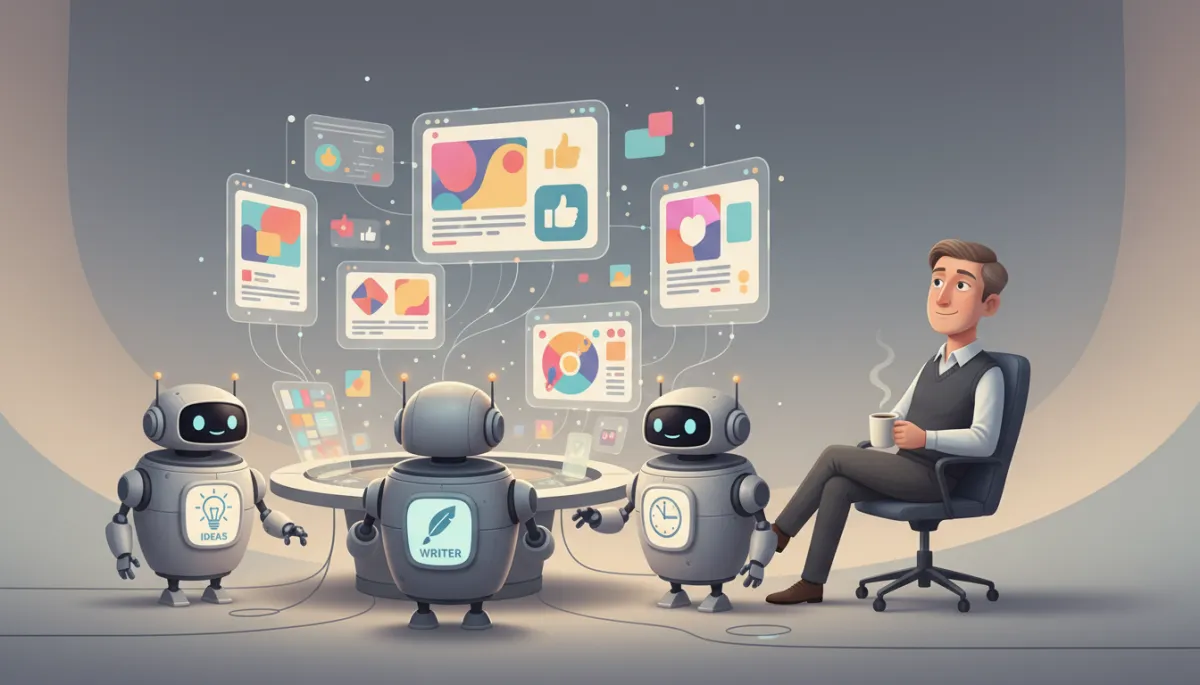
Intelligent tools turn scattered manual tasks into a coordinated, always-on content system.
How Intelligent Tools and Automation Transform Social Content Workflows
1. Smarter Ideation and Planning
Brainstorming no longer has to start with a blank page. AI‑powered platforms like Buffer, SocialBee, and Copy.ai can generate post ideas, hooks, and headlines tailored to your audience and goals. Strategic AI co‑pilots analyze past performance, competitor content, and emerging trends to recommend topics with the highest potential impact. Instead of guessing what will resonate, you’re working from a data‑backed shortlist of ideas.
💡 Pro Tip: Give your AI tools real context—brand voice, audience personas, and campaign objectives—so ideation aligns with your strategy instead of producing generic content.
2. Drafting and Designing at Scale
Once you have ideas, intelligent tools can quickly turn them into ready‑to‑publish posts. Generative AI writes platform‑specific captions, adjusts tone, and even suggests hashtags. Tools like SocialBee and Agorapulse can create multiple caption variations from a single input, so A/B testing becomes effortless. Visual tools—such as Canva’s AI features or integrated generators in social platforms—help produce on‑brand graphics and short videos without needing a full design team.
For media‑heavy brands, specialized tools like Opus Clip and Submagic repurpose long‑form videos into bite‑sized, captioned clips optimized for TikTok, Reels, and YouTube Shorts. This kind of repurposing is a hallmark of intelligent creation: instead of constantly starting from zero, you squeeze more value from every asset you produce.
3. Personalization and Audience Targeting
Intelligent content creation also means speaking differently to different segments. AI and predictive analytics can identify which topics, formats, and posting times work best for each audience slice. Some platforms, like InVideo AI, go further by automatically tailoring content for specific demographics, interests, or customer journey stages—and then scheduling posts accordingly.
This level of personalization was once reserved for enterprise brands with large teams and budgets. Now, even small businesses and solo creators can use these capabilities through accessible tools and affordable plans, from Buffer’s free tier to SocialBee’s entry‑level subscriptions.
4. Smart Scheduling and Cross‑Platform Publishing
Intelligent scheduling is one of the clearest ways to move beyond manual posting. Tools like Agorapulse and Hootsuite AI analyze your audience’s behavior to suggest the best times to post on each platform. They can automatically queue content, recycle high‑performing evergreen posts, and ensure your feeds stay active even when your team is offline or focused on other projects.
Instead of logging into five different apps throughout the day, you work from a single calendar that orchestrates X, Instagram, Facebook, LinkedIn, TikTok, YouTube, Pinterest, and more. This not only saves time but also helps maintain a cohesive brand story across channels.
5. Continuous Optimization and Learning
The “intelligent” part doesn’t stop once a post goes live. Strategic AI co‑pilots monitor performance in real time, flagging which posts are outperforming expectations and which are falling flat. They can recommend tweaks—such as changing hooks, visuals, or posting times—and some systems can even adjust campaigns autonomously based on results, similar to programmatic ad optimization in paid media (Forbes; Business Insider on automation trends).
Over time, this creates a self‑improving loop: your content strategy becomes sharper, your creative gets more relevant, and your team spends less time guessing and more time refining what works.
Balancing Automation with Authenticity and Human Craft
With all this automation, it’s natural to worry that social media will become a wall of generic, AI‑generated noise. Consumers share that concern—which is why authenticity and human craft are becoming more valuable, not less. Design trends for 2026 highlight a growing “tactile rebellion”: imperfect, handmade visuals and warmer textures that stand out against polished AI aesthetics (CreativeBloq, 2026).
Intelligent content creation doesn’t mean removing humans from the process. It means reserving human effort for the parts that truly need it:
Crafting your brand story and values.
Responding to comments and DMs with genuine empathy and insight.
Reviewing and refining AI‑generated content to ensure it sounds like you, not like “an AI.”
📌 Key Takeaway: Let automation handle the volume and logistics, but keep humans in charge of voice, ethics, and relationships. That’s where trust is built.
Practical Steps to Move Beyond Manual Posting
Step 1: Audit Your Current Workflow
Start by mapping how you currently create and publish content. Who does what? How long does each step take? Where do delays or frustrations appear? This simple audit will highlight the best places to introduce intelligent tools—often ideation, repurposing, and scheduling are the lowest‑hanging fruit.
Step 2: Choose the Right AI‑Powered Platforms
Next, match tools to your needs and size:
Solo creators and small teams often thrive with Buffer or SocialBee—affordable, intuitive platforms that combine AI captioning, content recycling, and smart scheduling.
Growing brands and agencies may prefer Agorapulse or ContentStudio for broader network support, collaboration features, and deeper analytics.
Enterprises can look to Hootsuite AI or InVideo AI for advanced campaign automation, sentiment tracking, and ROI reporting across multiple teams and markets.
Step 3: Start with One or Two Use Cases
To avoid overwhelm, don’t try to automate everything at once. Pick one or two high‑impact use cases, such as:
Using AI to generate weekly content ideas and first‑draft captions from your blog posts or podcast episodes.
Setting up a smart scheduling calendar that automatically recycles your top 20 evergreen posts.
Measure the time saved and engagement improvements from these first steps. Use those wins to build confidence and secure buy‑in for deeper automation.
Step 4: Build Feedback Loops and Guardrails
As you automate more, put systems in place to keep your content aligned with brand, ethics, and regulations. Many modern AI tools now include compliance features like source attribution, bias detection, and watermarking (Smartli.ai, 2026). Combine these with internal guidelines on tone, imagery, and sensitive topics, and keep a human reviewer in the loop for final approval on key campaigns.
Step 5: Evolve from Operator to Creative Director
Over time, your role should shift from “person who posts things” to “person who directs the system.” Instead of manually executing every step, you’ll:
Set objectives and key messages for each campaign.
Brief your AI tools with examples and constraints.
Review outputs, refine, and approve rather than start from scratch.
This is the essence of moving beyond manual posting: you’re no longer the engine; you’re the architect.
FAQ: Intelligent Content Creation and Social Media Automation
Will intelligent content creation replace human social media managers?
No. It will replace repetitive, low‑value tasks, not strategic thinking or human connection. Social media managers will spend less time posting and more time on strategy, community building, partnerships, and creative direction. In many organizations, AI is already seen as a co‑pilot rather than a competitor.
Is AI‑generated content safe for my brand reputation?
Used thoughtfully, yes. Modern tools include safeguards like bias detection, plagiarism checking, and content watermarking. The key is to combine these with your own review process and clear brand guidelines. Treat AI outputs as strong drafts, not final word, and you can maintain both speed and safety.
How do I keep my voice authentic when using AI?
Feed your tools with examples of your best content and explicitly describe your tone—whether it’s playful, authoritative, or conversational. Many platforms now support “brand voice” training. Always review AI‑generated posts with the question, “Would I say this out loud?” If not, tweak it until it feels like you.
Do I need expensive enterprise tools to benefit from intelligent content creation?
Not at all. Many of the most powerful features—AI captioning, idea generation, smart scheduling—are available in affordable tools or even free tiers. Start with what matches your current scale, prove the value, and upgrade only when your needs outgrow your initial setup.
How will intelligent content creation evolve over the next few years?
Expect more autonomy and more integration. Agentic AI systems will manage entire multi‑channel campaigns, from planning to optimization, with humans setting goals and constraints. Multimodal capabilities will expand, making it easier to generate cohesive campaigns across video, audio, and interactive formats. At the same time, demand for human‑crafted, distinctive content will keep rising—so brands that combine automation with genuine creativity will stand out most.
Conclusion: Welcome to the Era of Intelligent Content Creation
The era of intelligent content creation is not a distant future—it’s here. In a digital marketing landscape defined by speed, complexity, and constant change, clinging to manual posting is like insisting on hand‑writing every customer email. It’s admirable, but it’s no longer practical if you want to compete and grow.
By embracing AI and automation as strategic partners, you can turn social media from an exhausting treadmill into a powerful engine for visibility and connection. Intelligent tools help you generate better ideas, produce content faster, personalize at scale, and learn from every post—while freeing your team to do what humans do best: tell stories, build trust, and make creative leaps that no algorithm can replicate.
Moving beyond manual posting doesn’t mean losing control. It means designing a smarter system, where your strategy leads and technology amplifies. Start small, experiment, and keep your audience at the center of every decision. Step by step, you’ll feel the shift—from reactive content scrambling to confident, intelligent creation that truly supports your brand’s long‑term growth.